11, 42, 20... numbers that I will always associate with Penang. But before that, some backgrounder.
Penang is a state of Malaysia. Located on the northwestern part of the country, part of it is Penang Island, but a larger area is in peninsular Malaysia. Penang Island is connected to the mainland by two very long bridges. The first bridge is 13km long and the second is even longer at 26km (!).

Lorna and I went to Penang to attend the regular CEE-East Asia Conference (CEE stands for Catholic Engaged Encounter). This is held every three years (the last one in 2011 was in Manila). We were going in our capacity as servant leaders of CEE Philippines. The conference proper was scheduled to start in the evening of November 6th but we decided to fly-in on the 5th to "acclimatize" (actually, so that I can do some birding, hehehe). We took an 8am Singapore airlines flight from Manila and landed in Changi airport three hours later. Being used to the sudden touchdowns followed by the abrupt braking of the planes landing in the Busuanga airport, I was pleasantly surprised when the touchdown by the jumbo jet at Changi was so gentle. The big plane felt like it was as light as a feather. At the terminal, one cannot help but admire (and drool), at how vast and beautiful is this complex (one also hopes/prays that NAIA becomes like this within our lifetime). Since we had a one and a half hour lay-over, we walked around a bit looking at the shops. And though we ate during the flight, we could not help ourselves when we saw Lakhsa in one restaurant. We later boarded a Silkair plane for the one hour flight to Penang.
While waiting outside the Penang terminal for the car that will pick us up, I saw a bunch of black birds flying from tree to tree. They looked like crows but not exactly like our crows in the Philippines. I was tempted to take out my camera but then our "sundo" arrived before I could do so. At the retreat house, we were met by Fr. Gerard, a Malaysian priest we met in 2011, and by Joseph and Terry, our friends from Singapore, who were also in town for the conference. After settling down, we went to the nearby seminary (where Fr. G., is the rector), for snacks. Afterwards, we went to the night market at Batu Ferringi and after that, dined at the hawker food plaza called Viva, near Stella Maris. The food was great (and the prices very reasonable)! Lorna also discovered a local fruit juice called Ambra (or Umbra).

Joseph and I sharing a bottle of ice cold Guinness
We were back in our room by about eleven and I immediately began preparing for my birding trip the following day (Lorna would go shopping with Jo&Terri). Disaster struck when I found that all my four batteries needed to be charged and the wall sockets did not match my plugs!!! It completely escaped my mind that Singapore and Malaysia had different wall sockets. I went next door to check if Joseph had an adaptor but he didn't. And it was too late to go out and buy one. Panic!!! I was cursing myself when Lorna suggested that I text my guide and ask if he has any spare battery that I can borrow (or maybe he knows where to borrow. Failing that, maybe he can bring an adaptor early morning). It was already 11:30 and I was hesitant to do so because we were meeting at 6:00am the following morning and he was probably asleep. But I was desperate so I texted Mr. Choo, hoping he was still up. He immediately answered and asked what my camera and battery model was. After telling him, he replied that he can lend me one. Yahoo!!! From despair to jubilation in a matter of seconds (what would I do without Lorna?).
I was up at 5am, showered, dressed up (quietly, so as not to wake Lorna), and was at the gate of the retreat house by 6am. I found a Nissan X-trail parked by the gate and I met Mr. Choy Wai Mun (Mr. Choo's partner). As soon as I got in the car, he handed me the camera battery from Mr. Choo. And off we went. As we were driving, Mun, asked me what my target birds were, how I usually bird, how many hours I had, do I use calls, is it okay if we walk, am I more of a bird photographer or a bird watcher, etc., etc. This helped him plan our trip and our first stop would be Air Hitam Dalam, which was really my target area. It was first suggested to me by Vincent Ng, a birder friend from Singapore. I told him that I did some research and I read a couple of blogs about this place. It turned out, one of the blogs was his. Actually, my top three targets were the Mangrove Pitta, Blue Winged Pitta and the male Asian Paradise Flycatcher. But in my two plus years of birding, I have found it better not to make any "firm" targets and just let nature present me with whatever it wants. So I just told Mun that I would like to see these IF possible but it was not mandatory. I wanted to see as many species as I can and hopefully get decent photos.
We crossed the Penang bridge and reached peninsular Malaysia around 6:30am which was still so dark so we stopped at a local eatery. After a quick breakfast of Roti Chanai, (hope I spelled that right), we were off to Air Hitam Dalam, pronounced as "Ai Itam Dalam" (or at least that's how it sounded to me).

Air Hitam Dalam, or Deep Black Water. Interestingly, dalam (black), sounds similar to the Tagalog dilim or the Cuyonon delem (both meaning dark, which is also similar to black).
Air Hitam Dalam is a swampy area that is crisscrossed by concrete elevated walkways (represented by the red lines in the aerial map above). After parking, we set off, with Mun leading the way. Incidentally, Mun is also a bird photographer, so he also had his camera with him.
The forest was alive with sounds - of birds, of frogs, of insects, etc. Right away, we saw several monkeys, some of them on the walk ways. The first bird we saw was a Dollar Bird, which unfortunately was too far to photograph. But this bird is actually a lifer for me. So lifer #1. A short while later Mun, tapped me on the shoulder, pointed to a tree and quietly said Common Flameback Woodpecker, a bird that is so similar to our Spot Throated Flameback in Palawan. Actually, I think the Spot Throated was split from the Common a year or so ago.

Common Flameback Woodpecker, lifer #2
Walking further on, Mun, exclaimed Black Kite(!), I saw it flying across but all I managed was a blurry silhouette, still it was lifer #3. All of these happened within the first twenty minutes. (Wow!). Then a Crested Serpent Eagle also did a fly-by. Walking back to where we saw the Flameback, we saw two birds fly across the trail and perch in one of the trees, the first was a female Common Flameback but the second was a Streak Breasted Woodpecker. I ignored the former and concentrated on the latter, because it was lifer #4. It was difficult to see because it was perched high up and the leaves were so wide. But it went out long enough for me to capture it in my camera.

Streak Breasted Woodpecker, lifer #4

A photo of me while shooting the Streak Breasted Woodpecker at Air Hitam Dalam. Photo courtesy of super guide, Choy Wai Mun.
A few steps later, we encountered a Crested Serpent Eagle perched on a low branch. Mun and I both fired away and the bird never left. On another tree, we also saw a White Collared Kingfisher.
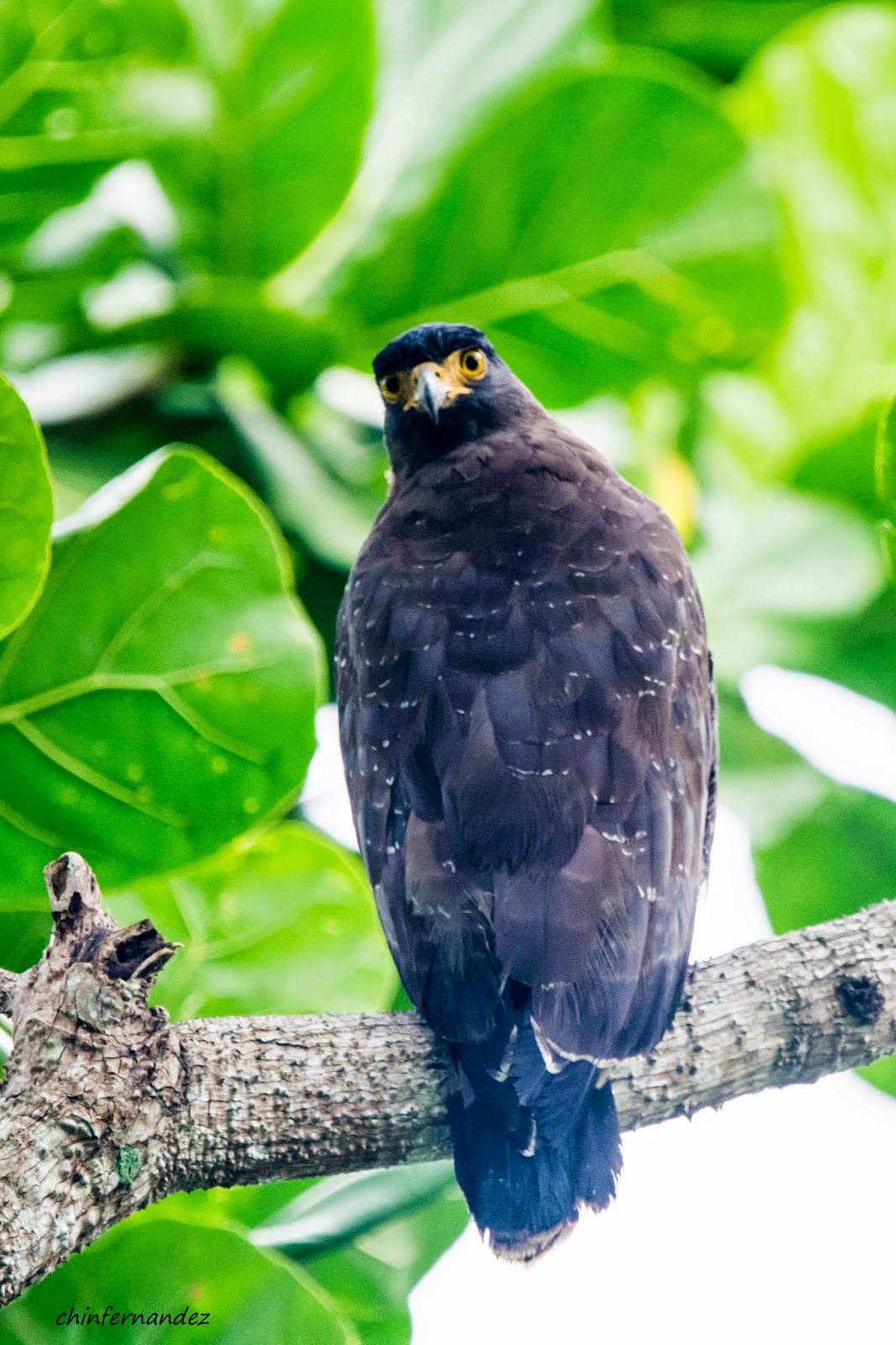
Crested Serpent Eagle, looking back at me, as if saying, don't you have enough photos already?
We walked back to Mun's car because according to him, the parking lot was the spot where the Mangrove Blue Flycatcher and the Yellow Rumped Flycatcher can be usually seen. Along the way, we spotted a couple of familiar birds, a Brown Shrike and a Yellow-vented Bulbul. At the parking lot, we saw another familiar bird, a Black-naped Oriole.
But there was no sign of the flycatchers so we set of again for the board walk. In one area, we saw the Mangrove Blue Flycatcher, which is a lifer for me, even if it is a resident of La Mesa Ecopark back home. However, due to the poor lighting, all my shots were blurry. Still this was lifer #5 for the day. A few meters away, Mun, pointed at something below, to our left, in one of the Nipa leaves (incidentally, they also call it Nipa), an Ashy Tailorbird, lifer #6. This bird looks so much like our Rufous Tailed Tailorbird in Coron. It also has a loud and distinctive call.

Ashy Tailorbird, lifer #6 for the day
We waited a bit for the Mangrove Blue to show itself again but no such luck. All the while, a bird was calling very loudly. I think Mun said it was an Abbot's Flycatcher (but I am not sure). It would have been a lifer but unfortunately, it never showed itself. We walked on and I saw some birds perched on a wire in the distance. Mun ID'ed them as the Common Myna. Common or not, it was lifer #7. But they were quite far for a decent shot.

A distant shot of Common Mynas, identified by the yellow around their eyes. Sorry for the poor image quality. Lifer #7
While walking, we also saw a Brahminy Kite in flight and a Spotted Dove perched on a bare faraway branch. Since both birds were not lifers for me, I did not pay them much attention. We went back again to the parking lot to see if the flycatchers are there already. Along the way, we saw again a Crested Serpent Eagle.

Crested Serpent Eagle
This time, the female Mangrove Blue Flycatcher (as distinguished by the white feathers near the beak), decided to show up.


Female Mangrove Blue Flycatcher, lifer #5.
When the bird left, we set out again and I saw something large fly across somewhere to my right. Mun, quickly said, Black Kite. Again, all I managed was a couple of backlit shots. Here is a backlit and "noisy" image of the Black Kite in flight.

Black Kite, lifer #2
After the Kite, we saw another bird high above to our left. It was a challenge photographing this one as it was perched almost directly above us. We strained our necks trying to get a good angle. That it was somewhat backlit just made it more difficult. Greater Racket Tailed Drongo, lifer #8.


Greater Racket Tailed Drongo, lifer #8.
It was almost time to go, so we headed back to the parking lot. I saw some birds perched on a distant bare branch and I snapped a couple of docu shots. It turned out to be one female Pink-necked Pigeon and two Coppersmith Barbets.

Female Pink-necked Pigeon and Coppersmith Barbets
While drinking some water and eating a snack beside Mun's car, the male Mangrove Blue Flycatcher showed up.

Male Mangrove Blue Flycatcher
Right after we finished shooting the Mangrove Blue, the Yellow-rumped Flycatcher darted across. It was being chased by the male Mangrove Blue. With the Yellow-rumped gone, the Mangrove Blue resumed posing. Perhaps it did not want to share the limelight with the other bird.

The "selfish" male Mangrove Blue Flycatcher.
But Mun had a hunch that the other bird was perched nearby so he went back to the board walk leaving me with the MBFC. A couple of minutes later he was quietly waving for me to go to him. True enough the bird was there. Both Mun and I took a good number of shots from about 4 meters away. In the end, we were the ones who gave up. Yellow-rumped Flycatcher, lifer #9.

Yellow-rumped Flycatcher, lifer #9
We finally left Air Hitam Dalam at around 10:00am. In a nearby rice field we saw some Herons and Egrets. Mun pointed this juvenile Pond Heron. He said that at this stage (non-breeding), it is difficult to tell whether it's Chinese or Javan but since 75% of the Pond Herons in Penang are Chinese Pond Herons, this is most likely a Chinese Pond Heron. Either would be a lifer for me anyway.

Chinese Pond Heron, non-breeding plumage, lifer # 10

Back view of the Chinese Pond Heron, non-breeding plumage
Then we drove to another rice field. If I am not mistaken, the name of the place is Kubang Sumang (hope I got it right). We did car birding or dude birding and got the following birds:

Black-winged Stilt

Grey Headed Lapwing, lifer #11

At first Mun ID'ed this as a Common Snipe but he later messaged me and changed it to Swintail Snipe. I asked if he meant Swinhoe Snipe, he replied saying that the Swinhoe and Pintail Snipes are so similar and almost impossible to tell apart unless one can check the tail feathers. Hence, the term, Swintail (why not Pinhoe? hehehe). Snipe, lifer #12
At the edge of the rice fields were several peculiar looking buildings, with small holes. Mun explained to me that these were built for the swallows to nest in. After the nesting period and the birds have left, the nests are collected and sold to be made into bird's nest soup. To a Coronian used to the balinsasayaw trade, this was so unusual. I told him that the Tagbanuas of Coron Island did this but collected the nests from the deep dark caves of Calis, often with the use of a lot of ropes for them to hang on. Here in Penang, their swallows nest in a "condo".

Balinsasayaw "condo"

A small Monitor Lizard near a small stream.
After seeing the Monitor Lizard, a few smallish birds flew across the road. At first I thought they were European Tree Sparrows (what we call Maya in the Philippines), but when they perched, I saw that they weren't. Mun ID'ed them as Baya Weavers. During nesting, they weave a beautiful nest made of grass, hence the name. Their plumage also change color during mating season.

Baya Weaver, lifer #13
The last birds that I was able to photograph at this area were a couple of Purple Herons.

Adult Purple Heron

Juvenile Purple Heron
In addition to the ones in the photos, we also saw Little Egrets, Great Egrets, Intermediate Egrets, Wood Sandpipers, Common Sandpipers, Barn Swallows, Pacific Swallows, Blue Tailed Bee Eaters, Zebra Dove, and several White Throated Kingfishers.
We got back to the main road and had Indian food for lunch in a local eatery. It was a plate of rice with vegetables, and a choice of chicken or beef plus fried egg if one wants. It was essentially their version of a rice topping. Simple, filling and reasonably priced.
Mun said, our next stop was Pulao Burung, which meant Bird Island. It was actually a mangrove area and also the landfill. The trip took about an hour and somewhere along the way, I dozed off. When we got to the area, we saw a lot of cows with and birds, mostly egrets and crows but there were other birds too.

House Crow perched on the head of a cow, lifer #14

House Crow, under different lighting conditions, photographed the following day somewhere in the city center

Lesser Whistling Duck, lifer #15, on a pond beside the landfill

A not so sharp photo of a White-throated Kingfisher. These birds were all over the place.

Red-wattled Lapwing, our main target at Pulao Burung. A beautiful bird in my opinion. Lifer #16.

Red-wattled Lapwing, from another angle.

Further on, in the mangrove area, we saw another Crested Serpent Eagle perched on a low branch.

And a White Collared Kingfisher. This is a common bird in the Philippines but I found that their blue plumage was a deeper blue than what we have. Actually, I have always thought that the White Collared KF in Coron has bluer feathers than the White Collared KF that I see in LPPCHEA (which to me looks like it has a tinge of green). I find that the blue of the Penang bird is closer in color to the blue of the Collared KF of Coron. But I am not an expert in these things so I defer to the ornithologists.
While traversing the dirt road, we came across a LARGE Monitor Lizard blocking our path. Mun had to stop the car and let it cross. Nose to tail, it was at least three meters long, maybe even longer. The biggest Bayawak I have seen in my life.

Jurassic Park? A LARGE Monitor Lizard. I wouldn't want to meet this on foot.
We left the Bayawak and drove to the other side of the "island", closer to the landfill. The aroma reminded me of Payatas and Smoky Mountain but unlike those two, the garbage here was actually compacted in a neat pile. We passed the cows again and saw a few more birds.

Juvenile Jungle Myna, lifer #17

A flock of Egrets standing near the landfill. The area to the right was a pond. The upper right hand corner of the photo shows a portion of the landfill with the garbage neatly compacted.
Near this group of Egrets, we saw a couple of Yellow Wagtails and a Blue Tailed Bee Eater. Soon we turned back and left Pulao Burung. Just before we turned to the main highway, Mun's sharp eyes, noticed a Black Shouldered Kite flying high up. He stopped the car and rolled out the window. I was able to snap a couple of shots then my memory card was full, (what lousy timing!). The bird perched on a pole while I quickly put in a fresh card but the bird flew away before I could take more photos.

Black-shouldered Kite, lifer #18
It was around three o'clock already so we decided to go back to Penang Island in order to avoid the rush hour. When we passed the majestic Penang bridge, I mentally kicked myself for not switching to my short lens. My backpack was in the trunk (or the boot, as they call it in Malaysia), so there was no way for me to get it. Stopping in the middle of the bridge was out of the question. So I could only gawk at the tall and massive pillars of the central span.
We got to Penang Island an hour later and proceeded to a Durian orchard where we saw two more birds.

Female Scarlet-backed Flowerpecker, lifer #19. I also saw the more colorful male on two occasions but unfortunately, no photos.

And just before we headed back to Mun's car, we saw a Little Spiderhunter, lifer #20 for the day. Docu shot only.
At 4:30pm, we decided to call it a day. At this point, I was not yet sure how many I got exactly. As soon as I got back to our room at Stella Maris, I quickly showered and did my bird list while the trip was still fresh in my mind. The verdict: in 11 hours of birding, we saw 42 different species and I got 20 lifers - 11-42-20.
I did not see any of my top three targets but it didn't matter. As I said at the beginning of this very long post, I prefer to let nature present me with whatever it wants, and boy what a gift it gave me today.
Thank you Penang! Hopefully, someday, I can come back...


