Saturday, February 27, 2016

A blessing in disguise

The Calauit Wildlife Sanctuary in Busuanga has always been one of my favorite places in the Calamianes. Whenever I am in Coron and we have a tour group going to Calauit, I always make it a point to go with the group.  So when I learned we had a group going last February 21st, I decided to go (even if I had a wedding to attend at 3:30pm that same day). I wanted to see and photograph the Green Imperial Pigeon which is abundant in Calauit.  Perhaps I could also get a couple of other species not easily found in mainland Busuanga.

However, we were so busy on February 19 and 20 - Darayonan, CATE, and Palanca family meetings, food tasting of new dishes, photo shoot of these new dishes, a wedding function at Darayonan, more meetings - I actually ended my day past 12:00mn of Feb 20.  I needed to be up at 3:30am for the Calauit trip.  Woke up at 2:30am and decided it was too early so I dozed off.  When I woke up again, it was already 5:00am. The tour had already left.  Stayed in bed for a while but at 6am I decided to bird at Yulo King Ranch, (YKR).

When I arrived at the ranch, there was still fog in the "kereb" or meadows, what we now call the Calamian Savanah.
Morning mist at the Calamian Savanah

I espied some Egrets on top of a tall tree so I paused to snap a few shots.

Cattle Egrets, (Agrok)

I was driving slowly with both van windows open and scanning the trees.  I saw a bird on top of a bare tree which at that time I assumed to be a Crested Goshawk because I had previously seen one in the same tree. I stopped the van, stopped two shots while still seated at the driver's seat. 

Said bird has been identified as a Kestrel by famous British Ornithologist, Desmond Allen.

Kestrel, lifer #2 for 2016; #238 overall.

I then went down and circled the van to get my tripod. But as I rounded the van, I saw a bigger bird perched on a bare tree nearer to me! I just pointed my camera and clicked away. After several insurance shots, I got my tripod and took more photos.  At that time, I felt it was a Changeable Hawk-Eagle.  The ID has since been confirmed by Mr. Allen. he further said that it is a pale morph or light phase.

Changeable Hawk Eagle, pale morph.

Preparing to take off

Lift off!

I watched it fly away and perch on the tree where the Kestrel was. I took photos from the road side but it was so far (maybe 40-50 meters), so I decided to go nearer.  I walked through the meadow, stopping to shoot every few meters. I think the closest I got was about 20 meters.

Changeable Hawk Eagle

Changeable Hawk Eagle, majestically perched and surveying the surroundings.

After it flew away, I drove on and stooped at a tree that I knew was being frequented by Blue Headed Racquet Tailed Parrots.  True enough a flock was there but the position of the tree vis-a-vis the sun is always bad in the morning. And the Racquet Tails are experts in blending in the foliage. I was able to manage one passable shot.

Blue-headed Racquet Tailed Parrots - (Kilit) - female (left, hidden) and male (right)

Driving past the airport, I stopped by a clump of trees that are usually frequented by different birds.  A Pied Triller and an Ashy Drongo made an appearance.

Pied Triller

Ashy Drongo, (Salang Ikog)

After a while I decided to try the new road being built which will connect YKR to Busuanga without passing Sitio Carmelita (said road will link up with the National Highway near Kiwit.

The new road being constructed

Upon entering the road, a couple of Racquet Tails flew across but unfortunately didn't perch in the open.  I drove through but I reached the end of the paved portion near the trail to Guchie Falls without seeing much birds. Driving back, I saw a Brown Shrike perched on top of a bare tree.

Brown Shrike

Driving slowly, I could not help but stop and appreciate the scenery before me.

Morning scene at the Calamian Savanah.  Praying that this area stays this way.

The road back to town.

At approximately 9:30am, I happily ended my birding and headed back to town in high spirits knowing that I had good shots of the Changeable Hawk Eagle.

Thank you Lord for the beauty of your creation!


Wednesday, February 24, 2016

Spotting Spotty (part 2)

Because I was not that happy with my Spotty photos and because I wanted to be able to photograph the Cuckoos (Brush and Philippine Hawk), I was back at UP-D on February 11 where I again bumped into Jonas Liwag.  Spotty and the Cuckoos were a no show but the ever reliable Blue Rock Thrush entertained us. This time on the big tree in the parking lot.


Blue Rock Thrush (juvenile male)

On February 12, I posted on Facebook that I predict a lot of people in UPD the next day.  True enough, when I got there at 7am the following day, I saw fellow bird photographers Atty. Ramon Quisumbing, Wins Tornado, Prof. Bert Madrigal, Roy de Guzman Daantos, and Rocky Sison. Collectively, I call them the big guns on account of their big prime lenses (600, 800, 500, 600 and 800 respectively).  Miss Becky Chung Santos was also there and of course Jonas Liwag, who is in UP almost daily. 

The big guns were looking shooting the Blue Rock Thrush.  Bert and I went to the biology forest in search of Spotty and the Cuckoos. We saw some Barred Rails and White-breasted Water Hens in a creek.  Then a Cinnamon Bittern emerged from the bushes and flew across us and settled in some of tall grass.  Bert and I parted ways after that.  I went behind the Biology building to check if the Spotty was there but no such luck.

I was walking back to the Scops Owl area when I met a young bird photographer named Jon Villanueva.  I pointed the Barred Rails to him and while he was shooting it, the Cinnamon Bittern did another appearance. I then met a group of bird watchers led by Jops Josef who told me that the Spotty and the Cuckoo appeared near the Sops Owl area.  I hurriedly went there and found Jonas who showed me a photo in his LCD Screen - that of the Spotty with a grasshopper in its beak!!! 

Somebody called us to go to the other side because the Cuckoo was there so off we went but it had already left.  Then the big guns arrived but before they could even set up, we were called again by somebody (can't recall if it was Wins' or Ramon's driver) to go to the other side (near the Scops area).  When we got there, both Jonas and Jon were clicking away at Spotty who was kind enough to perch on an open branch about 5 meters away from the concrete pathway.  The big guns had to move back because it was not within their minimum focusing distance.  And for the next thirty minutes, we happily pressed our shutters as Spotty obliged. I even had to change memory cards at one point.  In the end, it was us who gave up. 

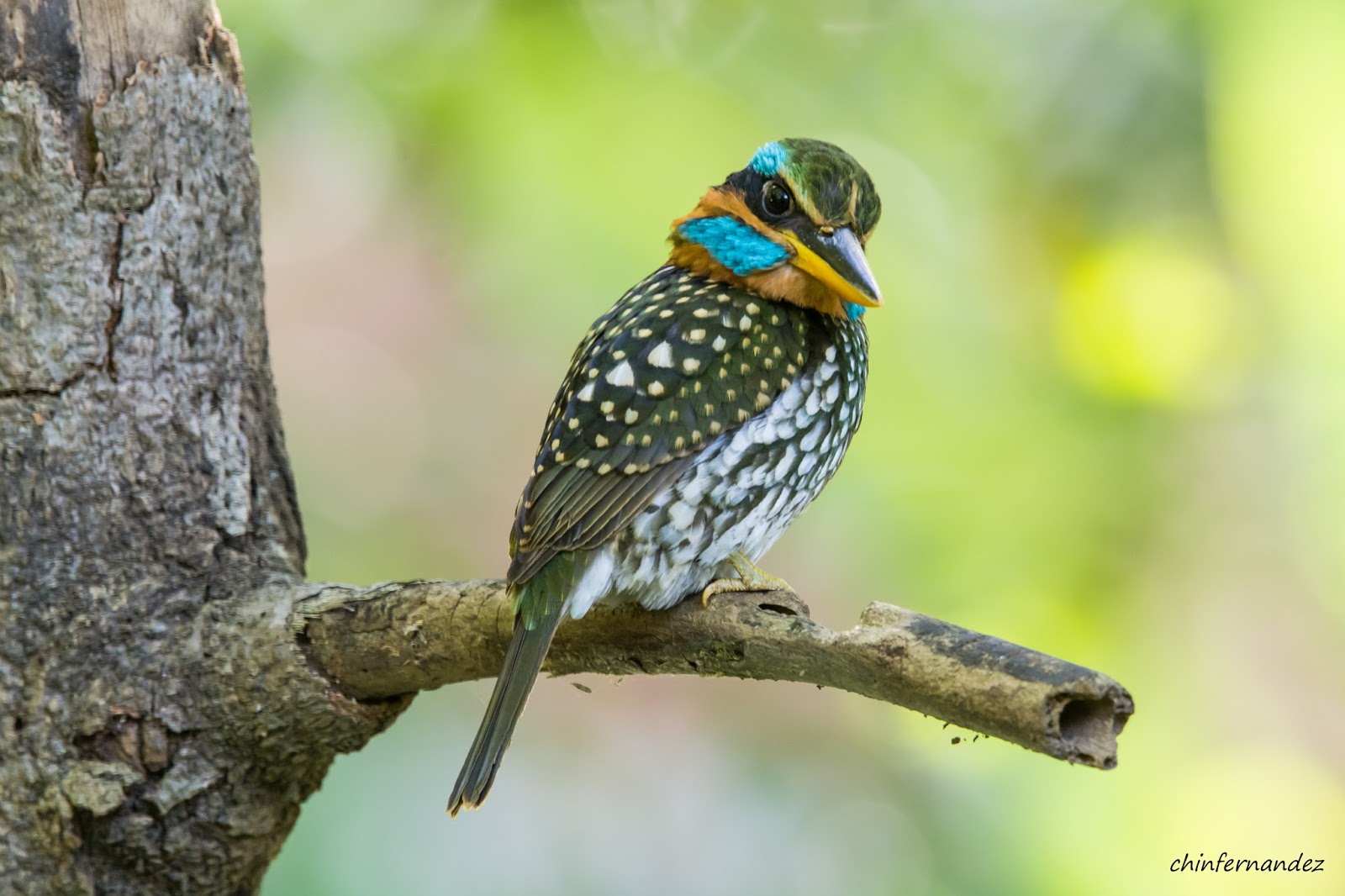
Presenting, UP-D's Spotted Wood Kingfisher, in various poses:


Spotted Wood Kingfisher (male)

Thank you Lord for Spotty!!!

Postscript: The Brush Cuckoo appeared but true to its name, it kept under the brush so we didn't get many shots.  Ramon and I both left at a little past 10am only to find out that the Philippine Hawk Cuckoo also made an appearance that enabled those still there full frame captures! 

Ahhh... the joys of birding...but still thank you Spotty.

Spotting Spotty (part 1)

The Spotted Wood Kingfisher is one of the more colorful birds that I have come across in the past three and a half years.  I first became aware of it in late 2013 when said bird appeared at the La Mesa Ecopark and stayed for several months.  It would perch for long minutes beside the trail allowing the many photographers who trooped to LMEP, close and eye-popping captures.  Except me, it seems.  I saw the bird in LMEP twice in October 2013 and once in January 2014.  All close distances but somehow non of my shots were "exhibit" quality.  They were okay but not good enough to be framed. I again saw Spotty again in October 2015 while guiding a group of foreign bird photographers but sadly same results.  In November 2015, during the APEC break, I saw the female Spotty in Mabitac, Laguna but again, I was not happy with the results.  

When Jonas Liwag, a birder friend started posting his shots of the Spotted Wood Kingfisher in the UP Diliman campus, I got excited because I am in UP-D practically everyday so I felt I would finally be able to get a good photo.  I started looking for it on January 26 but no luck.  Same results on January 27, 28, and February 1.  Went to Coron for a short trip on February 2 to 5. On February 8, Chinese New Year, I was back in UP where I bumped into several bird photographers at the parking lot frequented by the Blue Rock Thrush. 

From left: Sean Melendres, Jonas Liwag, Ben Go, myself, Conrad Olayres, Ed Santos, Djop Tabaranza, Tony Lim, Caloy Pangilinan and Ven Rojas (photo courtesy of Ven Rojas).

As usual, the Blu Rock Thrush didn't disappoint. 

BRT posing on one of the chimneys

BRT on a natural perch for a change

Then the guard called our attention to a Philippine Pygmy Flowerpecker which was boring a hole in a tree at the edge of the parking lot allowing us to have close captures.  

Philippine Pygmy Woodpecker, boring a hole

The bird stayed busy oblivious of our presence that I was even able to do my first bird video.
Video of a Philippine Pygmy Woodpecker in action

After shooting the Pygmy, we went separate ways.  Ed, Djop and I went to the Scops Owl area where we saw the adult owl but it was hidden behind so many twigs. 

Then Spotty made an appearance and we were busy for the next thirty minutes or so.  I was able to get many decent shots but when Djop and Ed posted theirs on Facebook later that day, I found my shots not as nice in terms of sharpness.  I am not sure if it was my technique, or my settings, or my gear.  I did have a loose screw on my tripod which made it a bit wobbly. Whatever the case, though my shots were good, I was not fully satisfied because I felt they could be better. Sharing some of them. 


Spotted Wood Kingfisher (male)

After Spotty, we were able to photograph the baby Scops Owls although there were no clear shots.

Baby Philippine Scops Owl

Just as we were about to call it a day, another bird showed up. My first lifer for 2016! Unfortunately, it burrowed itself in a dark thicket that it was also difficult to shoot, especially with a wobbly tripod.  Conrad identifed it as a Brush Cuckoo.
Brush Cuckoo

After getting a stiff neck with the owls and the cuckoo, we decided to call it a day...


Tuesday, February 2, 2016

Finding Blue in Maroon Land

Migratory birds are just amazing.  They fly vast distances and appear in the same area every year.  One such bird is the Blue Rock Thrush. Almost every year, between October to March, it appears in a certain area in the UP Diliman campus.  Unfortunately, I was never able to get a good photo since I got into birding in 2012.  

Last January 26, I went to UPD to photograph the Philippine Scops Owl family and the Spotted Wood Kingfisher. I met up with fellow birders Jonas Liwag, Mark Chang and Albert Tamayo at the MSI parking lot. Before proceeding to the Owl area, Jonas suggested that we pass by the area frequented by the Blue Rock Thrush.  My face must have lit up at the mention of this bird.  Shortly after we arrived at the spot, the bird showed up but left before we could get good shots. It stayed in another tree too high and too far. I was crestfallen again. However, Albert was able to post a very decent shot of it later that day.  

We then went to the Owl area and met Nes Santiago, another fellow birder.  We saw the adult owl but not the babies.  And in keeping with our luck, there was no clear shot.  After a while we trudged to the new location of UP's Spotty.  Again, no such luck.  All we saw was a Pied Fantail and some Yellow-vented Bulbuls.

Going back we decided to swing by the Owl area again and found that one of the babies was there snuggled beside the parent. Again no clear shot. 

Philippine Scops Owl, parent and child

We left Jonas and Nes and went back to where we parked our cars. We looked at the Thrush again. Albert and I stayed a few minutes while Mark to the Philippine Nightjar. But no such luck and needing to work, we all called it a day.

The following day, January 27, after I dropped my younger son to his school in Katipunan, I made a quick trip to UPD to look for the thrush.  When I got to the place, I saw that there were people working on the roof of the building where we saw the bird the day before.  Grrrr.... Looking at the other (and taller), building, I saw the bird perched way up. I also looked at the owl family but saw only the parent on an even more difficult perch. I gave up and went home.

January 28, Thursday, my elder son had an early class at UP. So after I dropped him, I swung by the Thrush area and to my delight, there were no workers on the roof.  And saw that my target bird was already there.  It flew away before I could set up my gear. But within ten minutes, it was backed and I was able to get some decent shots.  

Blue Rock Thrush

Blue Rock Thrush

Encouraged by my luck with the Thrush, I decided to look at the owls once more.  Unfortunately, even the parent was not around.

Still I was very happy that I was finally able to get a decent photo of a Blue Rock Thrush, one of my favorite birds because of its color and because I find the name so cool.

Till the next sortie... 
 

Saturday, January 30, 2016

Pocket Birding

Pocket birding is a personal term that I use to refer to those short, usually planned birding trips, that I slot into my workday.  It can be an early morning trip to Capayas and I am back at Darayonan by 9am or a late afternoon sortie at Villa Khadine or Lualhati Park (4:30pm to 6:00pm). In Manila, it could be a short trip to La Mesa Ecopak or UP Diliman after I drop off my kids to school.  When in Coron, one of my favorite pocket birding trips is birding at Yulo King Ranch before a flight to Manila.  If time permits, I go to YKR at 6am and bird until it's time for me to check in to my flight.  Or I check-in first then go out and bird till we hear the plane coming.  Such was the case last January 24. I had a 12nn flight with Skyjet so I checked-in then went out to do a quick birding near the airport. In the case of YKR, this is also mostly "dude" birding (or birding while in a car/van).

No lifers but I got two of the usual suspects.  The first was a Spotted Dove perched as usual on an open branch.  This was near the Hornbill area. I was hoping the Talusi would show up again.   But no such luck.

Spotted Dove - "Lade" or "Ladu" in Cuyonon

Exploring the backroads, led us to a quarry site where we saw a Crested Serpent Eagle on a tree on top of a small hill.  It was too far to photograph but the area seemed a good place to explore when I have more time.

As we headed back to the airport, we stopped at the horse stables and saw that the Balete tree beside it was fruiting and there were a lot of birds.   It was in this tree that I first saw a Hill Myna in October 2014.  But most of the birds this time were Asian Glossy Starlings and a couple of Ashy-fronted Bulbuls.  Then Rodel, our van driver, pointed at something through a gap in the leaves... Black-chinned Fruit Dove. 


And then we heard the plane approaching so we boarded the van and went back to the the terminal. Two good shots plus discovery of a new area in about forty-five minutes of pocket "dude" birding.  

Talusi...

I haven't really been able to go birding since early December. So last January 21st, when I finished most of my paperwork, I made a quick decision to do a quick birding trip.  I wanted to go to the Yulo King Ranch (the area near the airport in Coron), but since it was already past four o'clock in the afternoon I was hesitant, (YKR was 23 km away, usually a 30 minute drive).  But the desire to see some raptors and the Palawan  Hornbill won out so I decided to go for it.   I said a silent prayer asking for the Palawan Hornbill.

A short note about the Hornbill before I proceed. It has been one of my target birds ever since I started this hobby.  I first saw it in July 2014 at YKR (read about it here: http://chiwitchronicles.blogspot.com/2014/08/the-palawan-hornbill.html).  I have searched for them many times since then and saw them once but unfortunately, no photos. But our driver has seen them a couple of times in the same area. My friend Ichay Bulaong also saw them recently while she was biking in the area.  

As I approached the place last Thursday, I slowed down and began scanning the trees. I saw a bit of white on a far away tree, stopped the van, and decided to take a shot, (I forgot my bins). Lo and behold, it was a Palawan Hornbill.  I immediately turned off the engine, engaged the handbrake, braced the lens on the car door, and fired away.  I was so thrilled when after a couple of minutes, another bird appeared.  Here are some of images I was able to create:


Then both birds perched close enough to fit in one frame.

Mr. and Mrs. Hornbill

After a couple of shots, one of the birds moved to another tree that was hidden from my view.  I moved the van forward.  The bird was nearer but backlit and all I got was a silhouette.  Then it went back to the first tree. I had to back up the van to see them again.   


Together again...


Then one flew away, and the other immediately followed.


They perched on a tree beside the road (on my right), but hidden. I slowly get out of the van and look for a an opening in the leaves and branches but couldn't really find any.  The light was also bad.  I did manage a few shots but not really that good.   


The birds flew away after just a short while and went to nearby forest.  From the first two times that I saw them, I noticed that they are very skittish. Others who saw them say the same thing.  Maybe they are wary of humans. 

I waited awhile hoping that they would come back but they did not so I drove on. Near the airport, I saw a Barn Swallow perched on a wire.  

Barn Swallow

Driving on, I saw a Spotted Dove perched on a pole in the distance.

Spotted Dove

As I neared the area of a small hill where the former Australian ranch manager used to live, I saw several egrets beside some horses.  

Eastern Cattle Egret. Or is it a Horse Egret?

A few meters away, a couple of birds flew across the road and one perched on a tree near enough for me to get a shot.

Ashy Drongo

The sun was starting to set on my right when I saw this Spotted Dove perched on another bare tree. Why couldn't all birds behave like this?

Spotted Dove

It was starting to get dark so I headed back to town.  My last stop was another bare tree that I knew (from previous trips), was a place where Bee Eaters spend the night.  I was hoping to reach it while the light was still good.  But the light was not good anymore. It was a pity because there were so many of them in that tree.

Blue-throated Bee Eaters (photo brightened)

When I got back to the van, a flock of smallish birds suddenly took flight from one of the trees.  I pointed my camera at them and pressed the shutter, all the while knowing that the shots will probably not come out nice due to the poor lighting.   At the time I was shooting, I thought there were just Starlings but I found out later that they were Bee Eaters! 

A flock of Bee Eaters in flight

And just like that, it was time to go.  I hurried back to town because I had a diner appointment at 6:30pm (and it was already 6:10).  

Thank you Lord for the Kalaws (Hornbills) which I learned only yesterday, are called TALUSI in Cuyonon! Another addition to my Cuyonon bird dictionary.