Wednesday, March 25, 2020

Chasing Lifers: The Baihualing Gold Mine Day 2

The bountiful harvest of Day 1 left us in very high spirits. For the second day, we were going to Hide #3 for a specific target, the Slender-billed Scimitar Babbler and the secondary target was the Streak-breasted Scimitar Babbler.  We had seen the Black-streaked Scimitar Babbler the day before.

When we arrived at said hide, half the seats, were already occupied and the photographers were already shooting.  We quickly and quietly squeezed into the remaining seats, set up our gear and fired away.  As expected there were birds common to the previous day.  Sharing the ones that we just saw that day.

Streak-breasted Scimitar Babbler, one of our targets

Slender-billed Scimitar Babbler, the main target of the day.

Apparently, this is a sought after bird.  The group of Singaporeans whom we shared the hide with that morning, came back to Baihualing with this bird as one of their main targets.  They had all been to Baihualing the previous year but missed this bird. 

Then we saw a familiar bird, Ashy Drongo, or Salang-ikog (forked tail), in Cuyonon. 

Ashy Drongo

The parade of birds continued... here are some lifers.
Rufous-bellied Niltava, male

Streak-bresated Scimitar Babblers

A closer shot of the male Rufous-bellied Niltava

Blue-fronted Redstart, female

Grey-winged Blackbird, female

Slender-billed Scimitar Babbler

Slender-billed Scimitar Babbler

Blue Whistling Thrush

Blue Whistling Thrush

Rufous-bellied Niltava, male

Mrs. Gould's Sunbird, female

Snowy-browed Flycatcher

Snowy-browed Flycatcher, (docu shot)

White-gorgeted Flycatcher

White-gorgeted Flycatcher

Black-throated Sunbird, male

Grey-winged Blackbird, male

This is the shooting area of this hide...


Our lunch arrived promptly at noon and it was consumed quickly lest a new bird arrive while one is not in a position to shoot.  After eating, we packed our gear and transferred to a new hide (this was really our plan for the day).   

We were busy shooting something, when our host/landlord, Jeremy Yip arrived at the hide.  Then he pointed at something on one of the trees.  It took me a couple of minutes to see the bird because it blended so well with the tree trunk.  At it was perpetually moving so getting a decent shot was difficult.


Eurasian Tree Creeper

After the Brown Tree Creeper left, we continued look at the main shooting area.  The next bird was something I saw for a split second the day before - Long-tailed Sibia.


Long-tailed Sibia

Birds continued to come in waves as the afternoon wore on.  But many of them were species that we had already seen.  Still it gave us a chance to get better shots. Towards late afternoon, we got excited because a cute little bird arrived for the first time.


Scarlet Finch, female

We were getting ready to pack our gear when somebody, probably Raymond, blurted, Blue something and we all pointed our cameras at the newcomer and the familiar staccato of shutters filled the air. 


Blue-winged Laughing Thrush

Some photos of the afternoon shoot...

The hide and shooting area

Keith climbing up the steep trail

Our porter for the day, which turned out to be the owner of the 48-room "home-stay" we stayed in. He was also our driver that day.

A selfie while taking a breather


The hide keeper with the thermos of hot water and the remnants of lunch

The days haul was forty three (43) species with twelve (12) lifers to add to my previous day's tally, bringing the lifer count to 49.  


Friday, March 20, 2020

The Tubbataha Expedition: Cavili, Calusa, and Cagayancillo

Cavili (or Cawili)

After our brief sojourn at the South Atoll, the ship sailed for Cavili (or Cawili) Island, one of Cagayancillo's island barangays.  When I woke up early the following morning, this is what I saw from my cabin window.

Cavili Island

By agreement the night before, Martin had requested to be brought to the island much earlier so he could do some exploring.  After a quick breakfast, we were off.  I already had plenty of shots of the Brown Boobies, Brown Noddies, and Crested Terns at the North Atoll.  I was hoping for the Black Noddies and Red-footed Boobies at the South Atoll but the ongoing construction prevented that.  So for this day, I was hoping for these but Rommel told me that Black Noddies were not expected in these islands.  On the other hand, Frigate Birds were expected at Cavili so the hope for a Christmas Island Frigate Bird was still alive.

Upon landing, we immediately saw that the trees along the beach were dotted, with many white birds which turned out to be Red-footed Boobies!  And as we neared the trees, there were other birds as well - a few juvenile Brown Boobies and Frigate Birds.  

Red-footed Boobies

Greater Frigate Bird

Greater Frigate Bird

Red-footed Booby unloading in mid-air

Red-footed Booby

Red-footed Booby

Greater Frigate Bird, juvenile

A nesting Red-footed Booby

Red-footed Booby

Red-footed Booby

Four Frigate Birds in one frame

Aside from the Frigate Birds and Boobies, there were not many other birds in the island.  We ended up in the barrio of Cavili.  Strangely all the signs in the buildings said Bgy Cawili. But Rommel kept referring to the island as Cavili saying Cavili and Cawili were one and the same.  Anyway, the village reminded be of some of our barrios in Coron.


We took this opportunity to take a group photo (minus Martin, who was somewhere ahead of us).


While we were at this plaza, two young girls passed by selling buche (or was it maruya?), in any case I was so hungry that I bought some.  Soon everybody was buying.  For the foreigners in the group, it was the first time they tasted this Pinoy delicacy.  I wanted to buy Coke to go with it but the village had no ice so I decided against it (I was not even sure if they had Coke).  Anyway, we headed back to the beach and boarded the speedboat back to Narayana.  The ship pulled anchor while we were having lunch and was soon headed to Calusa Island. I managed a quick nap before I was woken up to say that we were leaving for Calusa Island.  

Calusa

We did not really see much birds at Calusa.  There was a distant Grey Imperial Pigeon which is quite a rare bird, though it was not a lifer for me as I had already seen it at Ursula Island a year ago (also from afar).    

The view from Calusa.  That's our ship, the MY Narayana in the distance.


 Cagayancillo town

We sailed again during the night and when we woke up, we were anchored off the town of Cagayancillo.  Birding wise, we had one target here - the so-called Cagayancillo White Eye which is actually a sub-species of a Yellowish White Eye found only in Cagayancillo.  This is the richmondi sub-species which may (or may not) be declared a separate species in the coming years. We boarded the speedboat for a twenty-five minute ride to town. Cagayancillo reminded me of Coron in the mid-70's - small narrow pier, few vehicles, few people, quiet town where everybody knew everybody else (how I miss that Coron).


Cagayancillo pantalan area

Upon disembarking, we immediately saw a tree filled with a flock of Grey-imperial Pigeons.  But it was quite far to get a good shot.  But to see this many Grey Imperial Pigeons in one tree was a delight.


There were no tricycles to be found.  And the one or two that passed us were loaded with cargoes and people from the newly arrived ''Batil" (wooden boat).  So we walked the narrow streets until we reached an area with trees.  There we found the Yellowish White-eye but it was forever moving so no good shots.  I realized that we were now close to the tree with the Grey Imperial Pigeons.  We found the tree but it was back-lit and most of the birds have left, except for two.  Sharing a closer but somewhat docu shot of this pair.

Grey Imperial Pigeons

One of the tricycles that we previously flagged returned and half of the group went with it leaving Rommel, Alan and me.  We decided to just follow the road leading out of the town in search of our target.  Several minutes later, our efforts paid off...

Yellowish White-eye, Zosterops nigrorum, richmondi ssp.

Though not considered a lifer since it is after all a Yellowish White-eye, (which I have seen elsewhere), the fact that this sub-species is found only on this tiny island in the middle of Sulu Sea, is pretty amazing.

By pre-arrangement, we took our lunch at the Cagayancillo wharf  and was back at Narayana early afternoon.  That night we had our final dinner aboard the ship as we sailed for Puerto Princessa.  

Puerto Princessa Bay

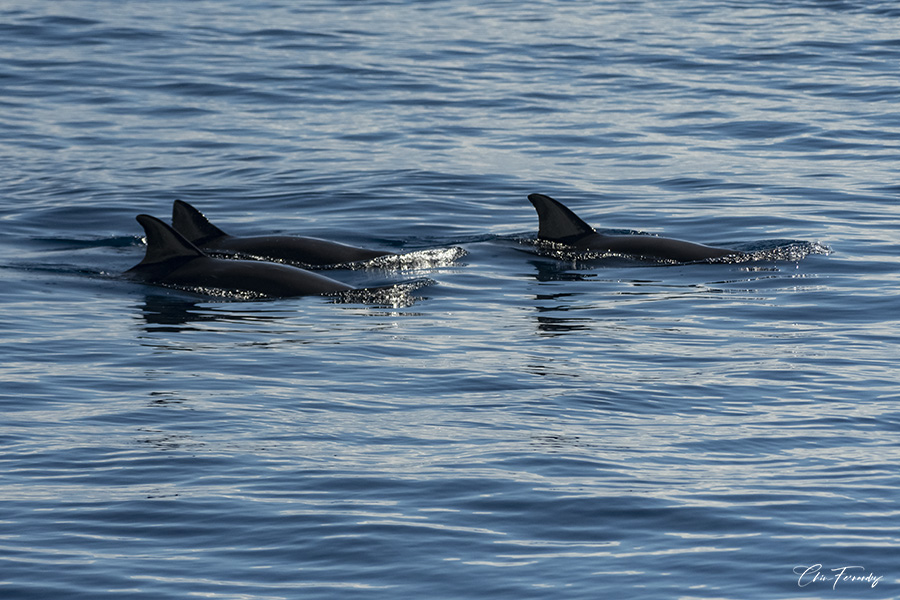
Our ETA at PPC was noontime so after breakfast, we spent time on deck watching for far off birds - mostly terns.  I was secretly hoping to see dolphins.   Fortunately, just as we were about to enter Puerto Princessa Bay, my prayers were answered.   I was told that these photos show Fraser's Dolphins. 


Fraser's Dolphin

Before long, we were docking at the Puerto Princessa port and saying our goodbyes.  I was dropped at the airport for my 4pm flight back to Manila.  It was almost 8pm when I reached our home in Quezon City and the first thing I did was to take a long shower and enjoyed the right temperature and pressure! (the shower at Narayana was often too hot).

Final Notes...

Tubbataha for me, is a special and magical place.  I enjoyed my trip immensely.  I am glad I did it and I have no regrets whatsoever.  Well, there is one, I wanted to experience it with my son Luis, but it was not possible (pretty sure the rest of my family wouldn't have enjoyed it).   However, I do not think it is for everybody.   Long boat trip, spartan conditions, no cell signal, less than ideal shooting conditions, cost, length of the trip, low number of species (as compared to other birding sites), are reasons that come to mind.  But as I said, for me, it was pure bliss...

For those who wish to bird at Tubbataha, please get in touch with Rommel Cruz at Wild Expeditions Palawan at https://www.facebook.com/wildexpeditionspalawan/


Thursday, February 27, 2020

Indigo, check!

I first became aware of this bird almost seven years ago when it became THE target bird La Mesa Eco Park together with the Spotted Wood Kingfisher.  These two birds dominated the Manila birding world in September and October 2013.  Even foreign birders came to visit.  And it was also a source of a big social media war - Facebook and Yahoo Groups (yes, it was still being used then), - between bird photographers (mainly WBPP) and other birders who held other views (this was my introduction to this difference of opinion). 

I only saw the Indigo-banded once during that time and while I was happy at capturing a lifer, I was not so happy with my shots.  I saw it again at Bangkong Kahoy in May 2014 and was able to get better shots.  When DRT and Avilon Zoo, came into our consciousness, many birders also got great shots there but not me.  So when I saw a post three weeks ago of an IBKF taken at LMEP, I immediately messaged the poster, Ralf Nabong, a good friend, and asked where he got it.  

On the day that we both shot the White's Thrush, Bong left the mini forest a few minutes ahead.  As I passed the area of the "Gods" on my way out,  I saw him waving at me and pointed the IBKF perch, saying that he heard it a few minutes earlier.  I was already running late so I was not able to stay.  But I made a mental note to come back for it when I had the time.  My chance came a week later.  I arrived at the site a little before 8am and found Prof Ferdie Llanes and Fidel Sy already seated with cameras mounted on tripods and pointed at the usual perch. Within ten minutes of setting up my gear, our target bird arrives and the sound of shutters clicking filled the (still) quiet air.  

Sharing two of the images I was able to create (one without a teleconverter, one with a 1.4x tc). 


Indigo-banded Kingfisher, female

Indigo-banded Kingfisher, big check!  Now where can I photograph the male?
  

Final Shot at Whitey

After three trips to La Mesa Ecopark to shoot the White's Thrush, I was still hot happy with my shots, especially after seeing much nicer photos of said bird perched on a palm tree eating its berries.  When I saw Nes Santiago post his beautiful photos I decided to give it another try.  Ever the gentleman birder, Sir Nes, as we fondly call him, provided me with a detailed direction that will put Google Maps and Waze to shame.  My son and I were scheduled to leave for UST at 6am, travel time 45 mins to one hour, so ETA uste at 7am. Then travel time to LMEP from Uste should be 30-45 mins considering I was going against the traffic. So I thought I will be at LMEP before 8am.  Well, as they say, the best laid plans of mice and men often go awry... we both woke up a bit later than usual, which meant we left the house almost 7am, traffic was heavier, etc etc.  I finally reached LMEP around 8:45am, gather my gear together, walk to the mini forest, follow the directions of Sir Nes.  I finally reached the appointed palm tree by 9:00am, and like an X on a treasure map, my target bird was there.  Set the tripod on the ground, point the camera, fire away... 


I had a one hour photo session with this bird who went about its business without minding me.  A far cry from the very skittish bird in January. At one point, several students passed by and stopped for a chat.  I pointed the bird to them and give a short explanation that this was a rare migrant.  After the usual ooohs and aaahs, one of them asked permission to take a cellphone photo of my LCD screen.  

Resident LMEP bird master Prof Ferdie Llanes and good friend Bong Nabong also joined me in the photo session.  We also met Doc Mylene A. Santos, a self confessed newbie birder.  She had a Nikon DSLR wither her took our photos while we were shooting. 


Bong suggested to Mylene to attach her camera to either my lens or Prof Ferdie's (we both use Nikon also), and got the surprise of our lives that her camera was a D850!  I quickly detached my camera body and attached her D850 (my dream camera at the moment), to my lens, did a couple of adjustments and fired several shots. And reluctantly returned the camera to Mylene :-). 

Before leaving the Ecopark, I swung by the other palm tree where the Black-chinned Fruit Dove was holding court.  I fired some shots but the lighting was not so good.  Besides we have this bird also in Coron.  I left LMEP a little before 11am , happy and satisfied with my shots of Whitey (finally!).   


Sunday, February 2, 2020

Another shot at Whitey...

A birder guest of mine once said that bird photographers are the among the most greedy in the world.  First they want a shot, any shot. Then a better one, then a full body, then a full frame of full body in good light in a good perch, etc.  Of course the ultimate would be a frameable and exhibit quality shot. This was said in jest of course but there is a certain grain of truth in it. We all want a better shot. So while I was happy that I was able to photograph the White's Thrush last January 10, I wanted a better one especially since this bird is a rather rare migrant.

I went back to LMEP late afternoon of January 18 but I did not even see the bird. Actually, I did not even see any bird. Hence...

When there are no birds, we make do with whatever Nature presents...

Finding a hole in my schedule yesterday, I decided to try my luck again. I arrived at the park around 1:30pm and met several birders while walking to the mini forest.  We greeted each other with a nod and a smile (I didn't know who they were).  I asked "quota na ba?" (meaning if they already got the White's Thrush).  They answered that it was a no show (oh no!).  And added that Djop (Tabaranza) was still there. I met him near the old stables as he was on his way out. We chatted a bit, he pointed out the fruiting palms and said that he saw the White's Thrush twice but no photos.  I set up my tripod near the fruiting palms and waited.  Waiting is never really my strong suit so after about twenty minutes, I decided to walk a bit and check the area near the "hollow blocks" where we saw the it last January 10.  I was a few meters away from the tip of the "rotunda which is actually a triangle" when I saw a slight movement on the ground on my right... and there he was... set down my tripod, fire a burst, wrong setting (aaargghh!!!), adjust settings (while imploring the birding gods that it does not go away), fire again... bird turns and walks a few steps, fumble at tripod knobs to re-aim, shoot again, bird turns and runs as muggles (non-birders), walk by. I strain my eyes looking at the dark forest floor hoping that it will come back for another round.  But it never did.  Sharing two decent photos...


White's Thrush

When I set out for La Mesa, my goal was to get a full body shot of the White's Thrush, which I accomplished but now I wish that that green blob (which is actually an out of focus leaf) is not there.  Remember what I said about bird photographers being greedy?

I waited for the White's Thrush to show up again and while waiting, LMEP's resident Ashy Ground Thrush entertained me... Thank you Lord for this beautiful and friendly bird...

Ashy Ground Thrush in its signature one-legged pose

I went back to the fruiting palm to see if the White's Thrush or the Brown-headed Thrush will show up but they did not.  Prof Ferdie Llanes joined me around four thirty. I left a little before five, happy that I was able to bird and get my target, (even with the green blob!). It was a good way to end a stressful week.  Thank you Lord for the opportunity.